Skip to content

Menu

Free GPIM Assessment Contact Us

JPEN

The OS for Autonomous Warehouse

Moving logistics facilities toward autonomy.

With GWES, our Logistics OS, we guide logistics facilities step by step toward autonomy.

INSIGHTS / WEEKLY

Warehouse
Tech Weekly

EditorTomo MiyataCEO, GROUND Inc.

01RESULTS

GROUND in numbers

GWES deployments have passed 100 sites across Japan.

  • 100+sites

    Sites using GWES (February 2026)

  • 2015

    Year GROUND Inc. was founded

  • 12modules

    In 3 layers. Choose the ones you need.

  • FY2026

    Won the Logistics Award “Frontline Innovation Special Award”

    See award details

02CHALLENGE

Four changes facing logistics operations

Operations that rely on experience and intuition can no longer keep up.

  • No. 1

    More SKUs, smaller lots, shorter lead times

    The growth of e-commerce has increased product variety and shortened lead times.

  • No. 2

    Labor shortages and an aging workforce

    Hiring gets harder every year, and the workforce on the floor is aging.

  • No. 3

    More complex supply chains

    From procurement to delivery, supply chains now span countries, and the whole is harder to see.

  • No. 4

    Demand for quality and visibility

    Shippers expect higher quality, and you need to show current status right away.

03GPIM

Change step by step with GPIM

GPIM is a yardstick that measures, on 5 levels, how far a logistics facility's operations have advanced.

Operating maturity of logistics facilities

Select a level for details

  1. LEVEL01

    Systematize

    Write down how work is done, and align processes, roles, and decision criteria.

  2. LEVEL02

    Visualize

    Make floor conditions visible in numbers, and bring workload and progress into one view.

  3. LEVEL03

    Automate

    Hand the work itself to machines, with robots taking on transport and sorting.

  4. LEVEL04

    Optimize

    Consider processes, people, and inventory together, and choose the best approach by calculation.

  5. LEVEL05

    Autonomize

    The facility decides and acts on its own, and people focus on exceptions and setting direction.

It is also a methodology for moving up to the next level.

04Our Goal

The logistics facility we aim for

From operations run on paper and whiteboards to operations run on data

GWES

Work back from the dispatch plan to synchronize loading and upstream processes

Use the same shipping data and progress to optimize each process

Module names link to details ↗←Plans and information→Goods flow
Process synchronization starting from the dispatch planFrom DO dispatch planning at lower right, the flow passes through LO packing and loading, and GWES at the center shares a common plan upstream. IA inventory analysis, SO slotting, WF workload forecasting, RA staffing, RO walking routes, PA progress tracking, and WA performance analysis appear at their positions in the facility. Blue shows plans and information; gray shows goods moving toward shipment. GWESSynced on shared data Share the plan upstream Goods flow WF Workload ForecastingForecastingRA Resource AllocatorStaffingIA Inventory AnalyzerInventorySO Slotting OptimizerStorageRO Routing OptimizerWalk routesPA Progress AnalyzerProgressLO Loading OptimizerPack & loadDO Delivery OptimizerDispatch Start Limited staging areain front of the docks
Align staging and loading with shipping to raise dock space efficiency and turnoverThe diagram illustrates how operations work.
Scroll sideways to see the whole diagram
Operations todayAutonomous operations
DecisionsMade by experience and intuitionMade with data and evidence
ScopeViewed site by site and process by processViewed across sites
Speed of improvementReviewed monthlySpotted and fixed on the spot
ScalingRebuilt for each siteThe same system extended across sites

Autonomy does not mean fully unmanned operations. It means shifting people's involvement from day-to-day management to evolving operations and making decisions.

05SOLUTIONS

GROUND's solutions

With three solutions, we improve both systems and the way people operate.

GWES

GROUND Warehouse Execution System

WAREHOUSE OS

What changes on the floor
You can see the workload in advance. Calculations decide where to place people and inventory.
GWES Progress Detail Dashboard: demo screen showing work and staff progress
PAProgress visibilityProgress visibility
GWES workload forecast results: demo screen showing the forecast graph and influencing factors
WFWorkload forecastingWorkload forecasting

GWES product screen (demo) · Click to enlarge

What it does
It is the foundational software that runs the warehouse. It makes management visible, automates it, and optimizes it.
Key features
  • Workload forecasting
  • Progress and performance analysis
  • Placement and travel-path optimization
A logistics facility with automated storage, conveyors, and mobile robots, monitored from a control panel screen (concept image)
Automated storage, conveyors, and mobile robots linked to a control panel (concept image)

Digital Integration

What it does
We connect and develop what GWES does not cover. We link existing systems and equipment, with GWES at the core.
What changes on the floor
Data that was scattered comes together in one place. Equipment and robots also run on the same foundation.
Key features
  • Platform design and build
  • Linking existing systems
  • Equipment and robot integration
The GWES RA demo interface showing a proposed shift plan by worker and time slot
GWES | Resource allocation optimization (RA): shift plan (demo interface)

Consulting & Engineering

What it does
We take on the side that people run. Looking at the whole picture, systems included, we help design, optimize, and streamline how goods move.
What changes on the floor
Advanced technology becomes part of daily procedures. Operations run at the same quality no matter who is in charge.
Key features
  • Logistics strategy planning
  • In-warehouse engineering
  • Current-state assessment and action planning

06BY ISSUE

GROUND's solutions by issue

Choose one issue you face today. You will see which of GROUND's three solutions leads and what it does.

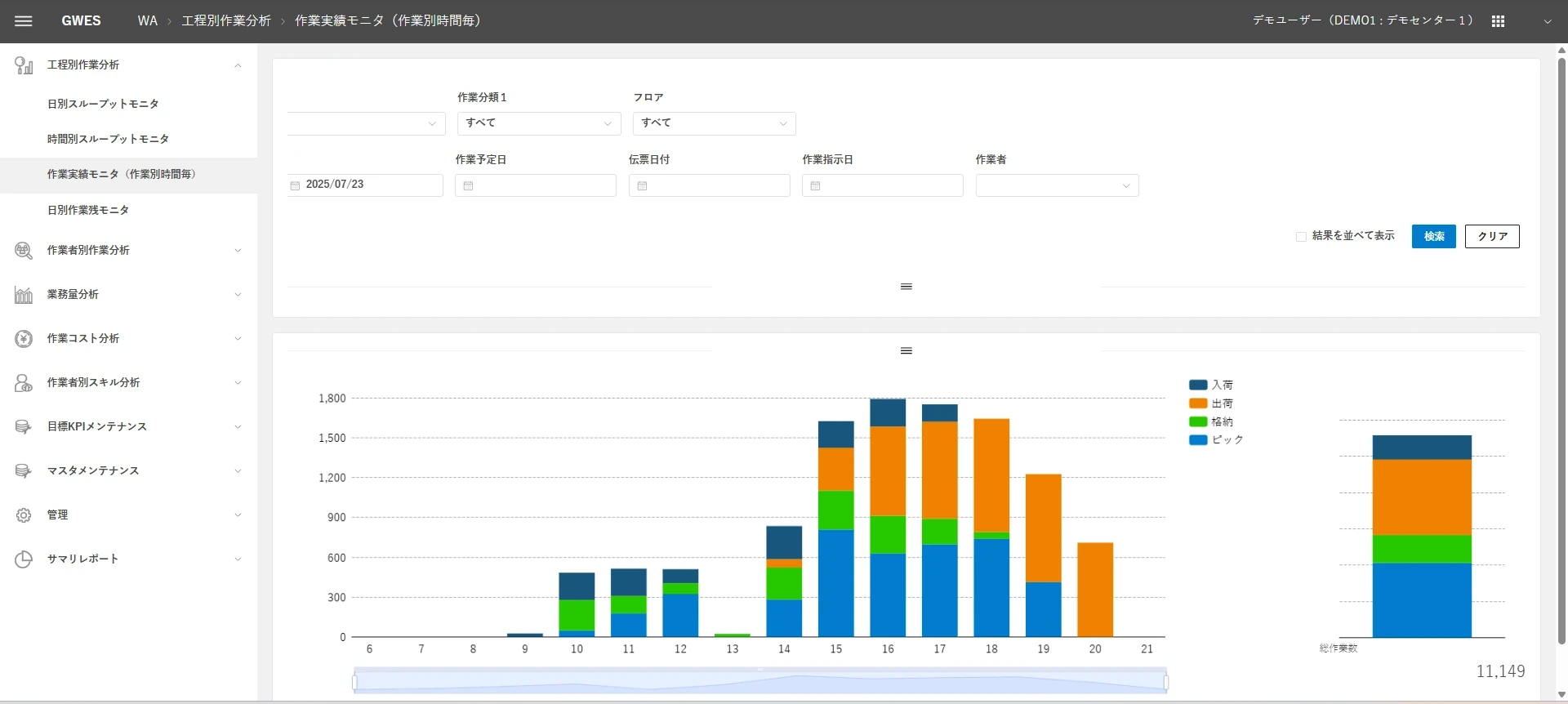
GWES Progress Analyzer demo screen
GWES | Progress Analyzer (demo screen)

Work progress is not visible in real time

Common scenarioTeams check progress through scheduled reports and floor rounds.

  • Lead

    GWES

    GROUND Warehouse Execution System

    It shows each process's progress against plan in real time on one screen. It catches early signs of delay, and results feed into plans for the following days.

    Modules used

  • Support

    Consulting & Engineering

    Based on the progress GWES shows, we set the metrics to watch and the criteria for decisions. We turn them into procedures that run at the same quality no matter who is in charge.

FIRST STEP

See where you stand with a free GPIM assessment

We clarify which level your logistics facility is at now and what to do next.